Request the same scope from suppliers: installation, filtration, training and long-term service included.
Engineering the next generation
Modern cremator technology
Electric heating, automated controls and integrated environmental systems are changing the buying decision. Look beyond the feature list to performance at your site.
01 / Technology
Electric heating
Resistance heating offers an alternative to gas-fired equipment. Compare electricity supply, warm-up and standby needs at your actual operating schedule.
Ask your supplier: What connection capacity and measured energy use does our site need?
02 / Technology
Smart process controls
Automated controls coordinate temperatures, oxygen and pressure. Cycle records help operators review performance and investigate alarms.
Ask your supplier: Can we export cycle data, and how are remote access and software support secured?
03 / Technology
Integrated emissions treatment
Secondary combustion and flue gas filtration work together as a complete system. Electric heating does not remove the need to assess process emissions.
Ask your supplier: Which local limits are guaranteed, under what conditions, and how will they be tested?
04 / Technology
Useful heat recovery
Recovered heat can support building services where there is suitable demand. Evaluate the heat exchanger, distribution and seasonal heat use together.
Ask your supplier: How much recovered heat can our building actually use across the year?
Manufacturer example, not an endorsement: Crematech describes electric chamber heating and automatic adjustment in its electric cremator overview, and discusses demand-led reuse in its heat recovery guidance. These are supplier statements, not independent performance verification; confirm current specifications and local suitability.
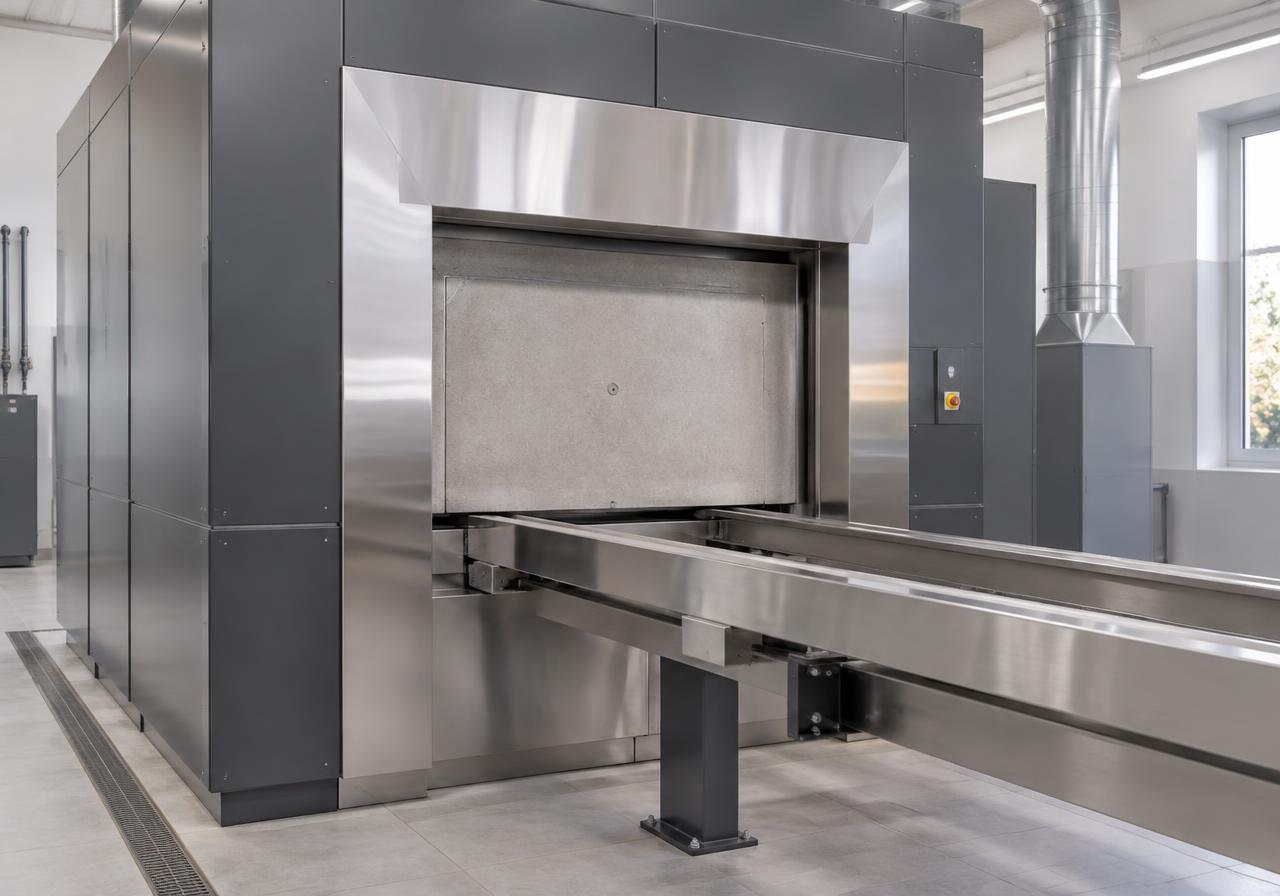
Confirm coffin dimensions, loading safety and maintenance access. AI-generated illustration.
Filtration & emissions
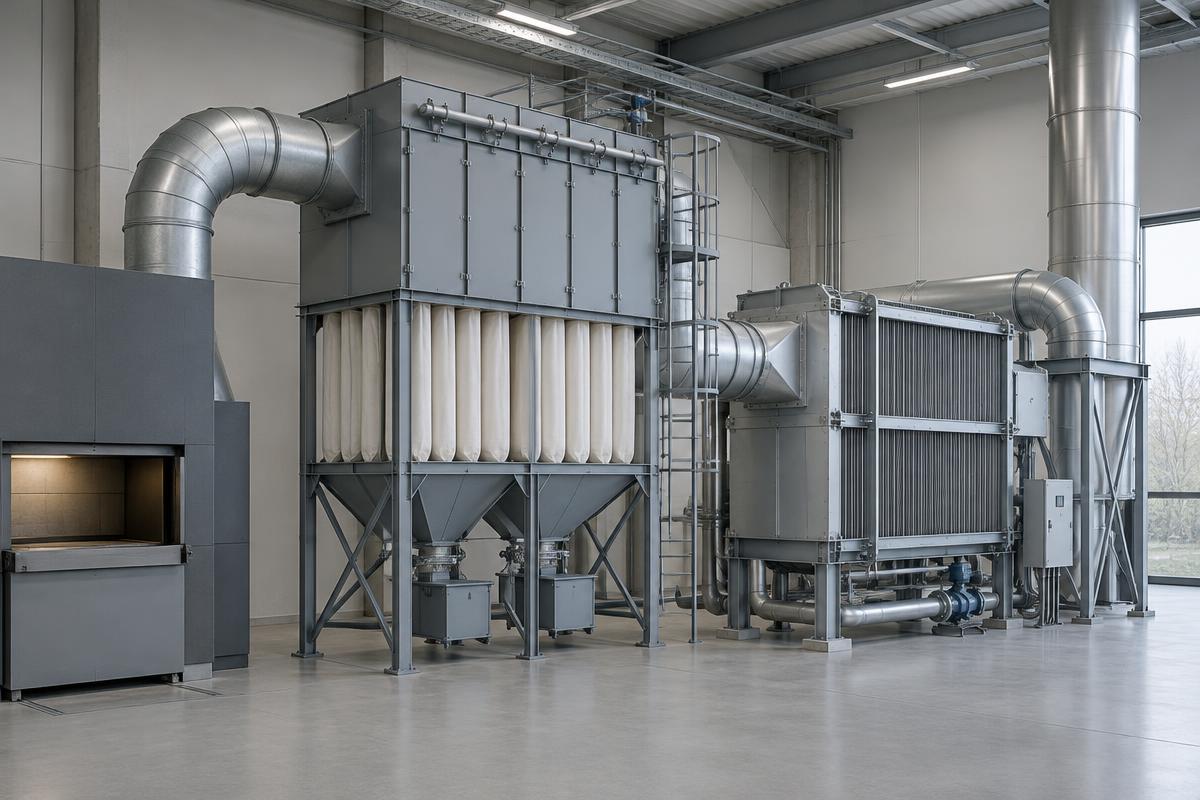
Plan flue gas cleaning, utilities and permit requirements together. AI-generated illustration.
Shortlist before you buy
Human cremator manufacturers
Browse 15 manufacturers with flame-cremation coverage in our directory. Listings are not rankings; confirm current human models and local availability with each supplier.
Part of the Dutch Facultatieve Group, Facultatieve Technologies designs and installs complete cremation lines: cremators, flue gas cooling, mercury and dioxin abatement, heat recovery and ash processing. The company is frequently specified in municipal and large-group tenders where a single supplier is expected to take responsibility for the full process from charging door to stack.
A division of Matthews International, this business is one of the best-known names in North American cremation. Its portfolio covers human cremators, bariatric units, pet cremation systems, processors and emission control. Many US funeral homes encounter Matthews equipment when buying an existing crematory.
Florida-based B&L Cremation Systems builds human and animal cremators, processors and ancillary equipment such as loaders and cooling. It is commonly shortlisted by independent funeral homes and pet crematories that want a compact, proven retort with straightforward maintenance.
U.S. Cremation Equipment supplies human and pet cremators alongside processors, cooling and handling equipment. Its offering is aimed at funeral homes and pet aftercare providers looking for a single US vendor for the cremation room.
Illinois-based Armil CFS manufactures cremators for human and animal cremation and offers service, relining and parts. Operators often contact Armil for refractory rebuilds as well as for new equipment.
DFW Europe is known for its cremulators and cremators, and supplies abatement and ancillary equipment for crematoria. Its processors are widely used in the UK and are often bought separately from the cremator itself.
A human cremator consists of a primary chamber, where the coffin and body are placed on a refractory hearth, and a secondary chamber where gases are held at high temperature long enough for complete combustion. Most European regulations require a minimum gas temperature of around 850 °C with a residence time of at least two seconds in the secondary chamber; North American rules are set by state and local air agencies. Burners, combustion air fans, an oxygen sensor and thermocouples are coordinated by a programmable logic controller (PLC) that adjusts the process continuously.
After the secondary chamber the flue gas is either released through a stack or, increasingly, cooled in a heat exchanger and cleaned in a filtration system before release. The heat recovered can warm the building, pre-heat combustion air or feed a district heating network.
Gas, oil or electric?
Natural gas remains the most common fuel worldwide because it gives rapid heat-up and flexible control. Propane or LPG is used where there is no gas grid, and light fuel oil is still found in some regions. Electric cremators, heated by resistance elements embedded in the refractory, have been used in Germany, Switzerland and the Netherlands for many years and are now gaining attention elsewhere because they can run on renewable electricity and produce lower flue gas volumes.
Electric cremators typically need a long initial heat-up and are best suited to sites with steady daily volumes that keep the hearth hot. Gas units are more forgiving for intermittent operation. Hybrid designs combine electric heating with a gas burner for the afterburner or peak demand. Ask each manufacturer for measured energy consumption per cremation at your expected daily volume, not just nameplate figures.
Capacity, throughput and bariatric cases
Throughput depends on body mass, coffin material, the cooling and processing cycle and whether the cremator stays hot between cases. As a rough planning figure, a cremator in continuous daytime operation completes several cremations per working day; sites running extended shifts achieve more. Rising obesity rates mean many operators now specify a bariatric chamber able to accept wider and heavier coffins, often up to 1,100 mm wide or more. Confirm the maximum coffin dimensions and weight in writing.
Single-ended or double-ended: double-ended units allow charging at one end and ash removal at the other.
Hot hearth or cold hearth designs affect cycle time and energy use.
Automatic charging machines reduce staff strain and improve consistency.
Refractory, construction and lifetime
The refractory lining protects the steel casing and stores heat. Its quality, thickness and installation determine fuel efficiency and how often a reline is needed, typically every few thousand cremations depending on use. Ask for the expected hearth life, the cost of a partial and full reline, and how long the cremator would be out of service. Modular refractory blocks can shorten downtime considerably.
Look also at the casing, door mechanisms, burner brand and controls. Components from widely available industrial brands are easier to service locally than proprietary parts that must be shipped from overseas.
Controls, data and remote support
Modern cremators record every cycle: temperatures, oxygen, fuel use, durations and alarms. This data supports compliance reporting, identification and chain-of-custody records, and preventive maintenance. Remote access lets the manufacturer diagnose faults without a site visit, but it must be secured properly. Ask how software updates are delivered and how long the control system will be supported.
Total cost of ownership
When comparing quotations, build a twenty-year model including purchase price, installation and building works, energy per cremation, refractory relines, filtration consumables such as activated carbon and lime, service contracts, emissions testing and staff time. Two cremators with similar purchase prices can differ considerably in lifetime cost. Our tender builder helps you ask every supplier for the same figures so the comparison is fair.
Finally, visit reference sites. Speak to operators who have run the same model for several years and ask about breakdowns, service response and energy bills. That conversation is often more valuable than any brochure.
Modern cremator technology: what matters to buyers
Modern human cremators combine thermal engineering with automated process control, emissions treatment and, where appropriate, heat recovery. The value is not simply a newer appearance or a longer feature list: it is whether the proposed installation can operate reliably at your volume, meet your permit conditions and be maintained by people who can reach your site. Compare complete systems and ask which capabilities are standard, optional or dependent on other equipment.
Electric cremation is still thermal cremation, not water cremation or alkaline hydrolysis. Electric heating elements supply heat to the chambers; combustion of the coffin and body still produces process gases that must be managed. Electricity sourcing influences the carbon comparison, while the site's power connection, operating schedule and standby requirements influence cost. Ask for measured performance over a representative working week rather than assuming that one technology is always the lowest-cost or lowest-impact choice.
Advanced controls can automatically adjust the process and record operating parameters, but automation does not replace trained staff, identification procedures or maintenance. Discuss alarm handling, access permissions, data ownership, export formats and the support lifetime of the control system. For remote diagnostics, require a clear agreement on authorised access, network security and how the system operates if connectivity is lost.
Heat recovery only delivers a useful benefit when the site has a suitable destination for the heat. Ask the equipment supplier and building-services designer to assess seasonal demand, exchanger location and maintenance together. Treat claimed savings as project-specific estimates to be checked, not universal guarantees. Reference installations and independent acceptance tests are more useful evidence than labels such as smart, green or next generation.
How to buy a human cremator
Start with the operation rather than the machine. Record annual cremations, peak daily demand, opening hours and the time available for cooling and processing. A funeral home introducing cremation, an established private crematorium replacing a unit and a municipality developing a multi-line site can need very different configurations. Give every supplier the same operating schedule so proposed capacity and energy figures can be compared on a common basis.
For an existing site, arrange a survey before finalising a shortlist. Delivery access, floor loading, chimney routing, ventilation, gas supply and available electrical capacity can change the scope substantially. Clarify whether the project includes removal of old equipment and how service will continue during installation. For a new crematorium, coordinate equipment drawings with the building design early rather than trying to fit a chosen machine into a finished room.
Use our equipment finder to organise your requirements, then compare manufacturer profiles for technology coverage, energy options and service questions. Directory inclusion is not a recommendation or proof that a supplier can deliver a particular model in your country. Confirm local availability, installation partners and reference sites directly before requesting a final proposal.
What should a human cremator quotation include?
A useful quotation prices the complete working installation, not only the cremator casing. Ask suppliers to identify the primary and secondary combustion system, control equipment, charging machine, flue connections, filtration, heat recovery and remains-processing equipment included. Building works, utilities upgrades, transport, lifting, commissioning, operator training and taxes should be explicitly included or excluded. This avoids mistaking a narrower scope for a better price.
Capacity and maximum coffin dimensions and weight, with the conditions used to demonstrate performance.
Measured energy use at your proposed schedule, including start-up, standby and auxiliary equipment.
Applicable emissions guarantees and the agreed independent acceptance-testing procedure.
Maintenance scope, refractory allowances, consumables, spare parts and service response arrangements.
Delivery milestones, warranty terms, training, documentation and responsibility for commissioning.
There is no reliable universal purchase price for a human cremator installation. The country, chamber design, energy supply, emissions equipment and construction scope all affect the result. Use the cost calculator to examine your own assumptions, not as a supplier price list. Compare proposals over the same operating horizon and ask suppliers to explain the evidence behind each running-cost estimate.
From shortlist to a confident purchasing decision
Choose evaluation criteria before quotations arrive. Decide which requirements are mandatory and which are preferences: permitted emissions, capacity, local maintenance support, delivery programme, energy performance and whole-life cost. Keep a written record of assumptions and exclusions. A balanced comparison makes clear where a lower initial price comes with more operating risk or where a higher price includes work another proposal leaves to you.
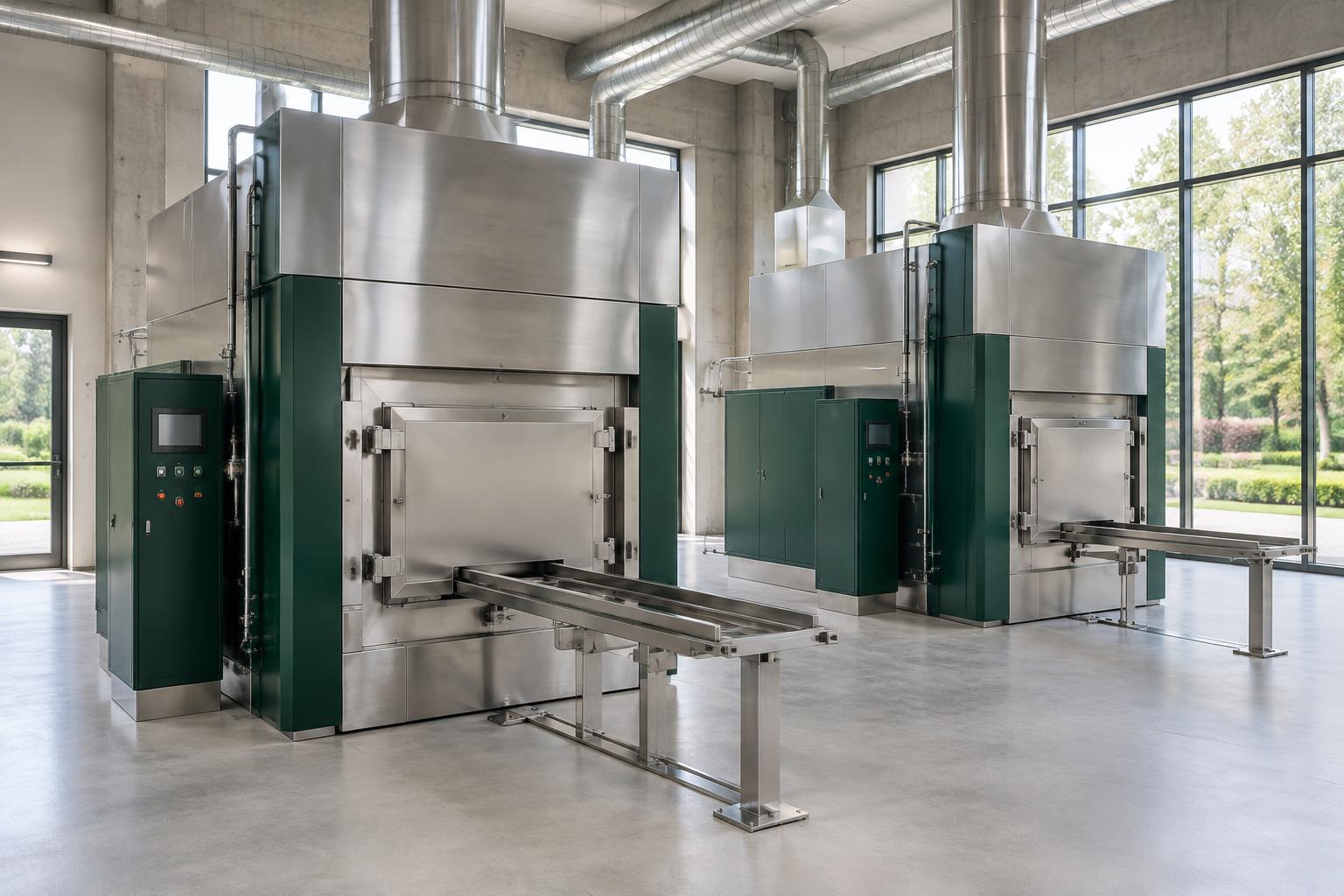
Speak to operators at comparable reference sites, ideally with similar volumes and energy conditions. Ask about downtime, access to engineers, parts availability, cleaning, software support and how actual consumption compares with the original proposal. Equipment pictures help explain layout, but cannot establish performance or compliance. The images on this page are AI-generated illustrations, not photographs of listed manufacturers' models.
Before signing, agree who obtains permits, who verifies performance and what happens if acceptance tests are not met. Local planning and environmental authorities determine requirements; this guide is not legal or engineering advice. Our quote service is free for buyers and can share a consented request with up to three relevant manufacturers. We may receive an introduction fee, which does not change our editorial comparisons.